
Alternate format: Annual Report - Access to Information Act - 2025 to 2026 (PDF, 1,22 MB)
Pursuant to subsection 94(1) of the Access to Information Act, this document contains the Annual Report to Parliament on the Administration of the Access to Information Act for 2025 to 2026 as submitted by the Minister of National Defence.
Table of contents
- Introduction
- Mandate of the Communications Security Establishment Canada
- Organizational Structure
- Delegation order
- Performance 2025-2026
- Training and awareness
- Policies, guidelines and procedures
- Proactive publication under Part 2 of the ATIA
- Initiatives and projects to improve Access to information
- Monitoring compliance
- Appendix I: Delegation of authority
Introduction
The purpose of the Access to Information Act is to extend the present laws of Canada to provide a right of access to information in records under the control of a federal government institution in accordance with the principles that:
- government information should be available to the public;
- necessary exceptions to the right of access should be limited and specific; and
- decisions on the disclosure of government information should be reviewed independently of government.
This is the thirteenth annual report prepared by the Communications Security Establishment Canada (CSE) and tabled in Parliament in accordance with section 94 of the Access to Information Act. It presents an overview of the agency’s activities and describes how the Access to Information (ATIP) and Privacy Office carried out its responsibilities under the Access to Information Act during the reporting period from 1 April 2025 to 31 March 2026.
Mandate of the Communications Security Establishment Canada
On August 1st, 2019, the Communications Security Establishment Act (CSE Act) entered into force as part of Bill C-59 (An Act respecting national security matters). The CSE Act sets out the five (5) aspects of CSE’s mandate:
- helping to protect and defend Canada’s most important cyber systems;
- acquiring foreign intelligence in support of the Government of Canada’s intelligence priorities;
- conducting defensive foreign cyber operations;
- conducting active foreign cyber operations; and
- providing technical and operational assistance to federal law enforcement and security agencies, the Canadian Forces and the Department of National Defence.
The CSE Act provides CSE with a modern set of authorities and an enhanced accountability framework with new oversight and review functions.
Organizational structure
The ATIP Office and Privacy Office are both part of the Review, Transparency and Information Sharing (RTIS) directorate in CSE’s Authorities, Compliance and Transparency (ACT) Branch.
The CSE ATIP Office has continued to grow since the last reporting period. The disclosures tasks beyond the processing of requests under the ATIA and PA, have necessitated the creation of a new ATIP team structure. In mid-January 2025, CSE’s ATIP team was divided into two separate teams, ATIP Intake and Proactive Disclosures team and ATIP Operations. The split between the teams is intended to address the backlog of requests, claim time extensions, when possible, streamline ATIP response processes and complaints. CSE’s ATIP Office backlog has led to an increased deemed refusal rate and complaints which it now seeks to address with this realignment. Our objective with this modification is to modernize our processes, improve efficiency and facilitate improvements to the ATIP Office’s ability to respect legislative timelines. CSE ATIP is working towards processing requests more promptly and has taken positive steps to establish efficient workflows while addressing team growth.
The ATIP Office includes a manager responsible for nine (9) full-time positions working in two (2) teams: ATIP Operations and ATIP Intake. At the end of the reporting period, the ATIP Operations team consisted of one (1) supervisor and four (4) analysts. The ATIP Intake team consisted of one (1) supervisor, two (2) analysts, and one (1) support officer.
In addition to preparing reports for Parliament and Treasury Board Secretariat (TBS), the ATIP Office acts on behalf of CSE as the delegated authority in dealings with TBS, and representatives of the federal Information and Privacy Commissioners regarding CSE’s administration of the Access to Information Act (ATIA) and Privacy Act (PA).
Specifically, the ATIP Operations and ATIP Intake teams are responsible for the following activities:
- Processing requests under the Access to Information Act and Privacy Act;
- Responding to consultation requests from other government institutions;
- Providing advice and guidance to senior management and staff of CSE on ATIP legislation and policy-related matters;
- Supporting CSE’s legislative compliance obligations under the Acts, including the application of their associated regulations, policies and guidelines;
- Representing CSE in ATIP Communities of practice, such as the TBS ATIP Community meetings;
- Drafting and implementing internal ATIP procedures, guidance documents and working aids; and,
- Providing training and other outreach initiatives to CSE staff on the administration of the Access to Information Act and the Privacy Act.
In FY 2025-26, privacy-related functions supporting compliance with Privacy Act, include policy, risk, training, and awareness, were realigned from Transparency and Information Sharing to the External Review team, with both teams remaining part of the RTIS directorate. This organizational change reflects the increasing strategic importance of privacy across the organization and will enhance CSE's ability to provide effective oversight, guidance, and engagement in response to evolving technologies, operational priorities, and privacy requirements. Looking ahead into next fiscal year, CSE will continue to advance and refine its privacy program to support strong governance, accountability, and service delivery.
During the 2025-2026 reporting period, the Privacy Office was comprised of one (1) manager responsible for seven (7) full-time positions, including one (1) supervisor, and six (6) analysts.
Specifically, the Privacy Office is responsible for the following activities:
- supporting Deputy Chief, Authorities, Compliance and Transparency (ACT), CSE’s Chief Privacy Officer in ensuring the institution's programs and activities are in accordance with the requirements of the Privacy Act and related policy instruments;
- identifying and managing privacy risks across the institution, partly by leading or supporting the development of Privacy Impact Assessments, Privacy Needs Analyses, System Identification Documents, Privacy Notice Statements, and maintenance of Personal Information Banks;
- supporting CSE’s legislative compliance obligations under the Privacy Act, including the application of associated regulations, policies and guidelines;
- identifying and managing privacy breaches and material privacy breaches;
- representing CSE in privacy protection communities of practice;
- coordinating the annual update of the institution’s Info Source publication, which includes a description of the agency’s organizational structure and record holdings;
- drafting and implementing privacy-related policies, internal procedures, guidance documents and working aids; and,
- providing training to CSE staff on the administration of the Privacy Act focusing on the protection of personal information.
CSE was not party to any service agreements under section 96 of the Access to Information Act during this reporting period.
Part 2: Proactive publications
Part 2 of the Access to Information Act outlines the need for government departments to proactively disclose information to the Canadian public. Although CSE works principally with sensitive, classified information, the organization is not exempt from these requirements and is committed to disclosing information where possible.
CSE’s Strategic Policy’s Parliamentary Affairs unit is primarily responsible for preparing material such as briefing binders for the Chief’s parliamentary committee appearances and transition material for a new Chief. This unit also supports the Department of National Defence’s publication of Question Period notes and/or transitional material for a new Minister as needed. Before these documents are posted on CSE’s website and the Government of Canada’s Proactive Disclosure site, CSE’s ATIP Intake team reviews all materials for sensitive, classified information that would be exempted or excluded should this information be requested under Part 1 of the Access to Information Act and prepared the material for publication as described below.
The CSE ATIP Intake team is responsible for the publication of reports tabled in Parliament which includes the ATIA and PA annual reports on the administration of each Act as well as the monthly publication of the list of briefing notes to the Chief, CSE.
For a breakdown of the groups and/or positions responsible for meeting each applicable proactive publication requirement under Part 2 of the Access to Information Act, see the section “Proactive Publication under Part 2 of the ATIA.”
Delegation order
Pursuant to section 95 of the Access to Information Act, the Minister of National Defence (MND), the Honourable David J. McGuinty, delegated the exercise of Access to Information Act authorities to designated officials within CSE. The Chief, CSE, the Deputy Chief, Authorities, Compliance and Transparency, the Director General, Review, Transparency and Information Sharing, the Director, Transparency and Information Sharing, and the Manager, Transparency and Disclosures hold full delegated authority. Limited authorities are also delegated to the Supervisor, ATIP Operations and the Supervisor, ATIP Intake.
The delegation order in effect at the end of 2025-2026 has been updated from an earlier organizational structure at CSE and a copy can be found in Appendix I of this report
Performance 2025-2026
Number and origin of formal requests
During the 2025-2026 reporting period, CSE received 91 requests under the ATIA (compared to 74, 52, 51, and 51, in 2024-2025, 2023-2024, 2022-2023, and 2021-2022, respectively) which is an increase from the last several reporting periods. CSE carried 45 requests from 2024-2025 and 133 from previous periods into 2025-2026 for a total of 269. By the end of the 2025-2026 fiscal year, CSE closed 85 requests and carried forward 184 into the next reporting period. As in previous years, the requests covered information that included highly sensitive material, for which complex processing is required. This increase in CSE’s request closure rate from 2024-2025 can be attributed to an increase in resources through staffing efforts and reorganization of the team to increase efficiency in processing requests. Requests from the media decreased from 38% in 2024-2025 to 32% in 2025-2026. Requests from the public and academia made up 43%, 20% and 23% respectively, a decrease from 54% in the previous fiscal year. The remaining 25% were received from individuals who declined to identify (5%), businesses (11%) and organizations (9%).
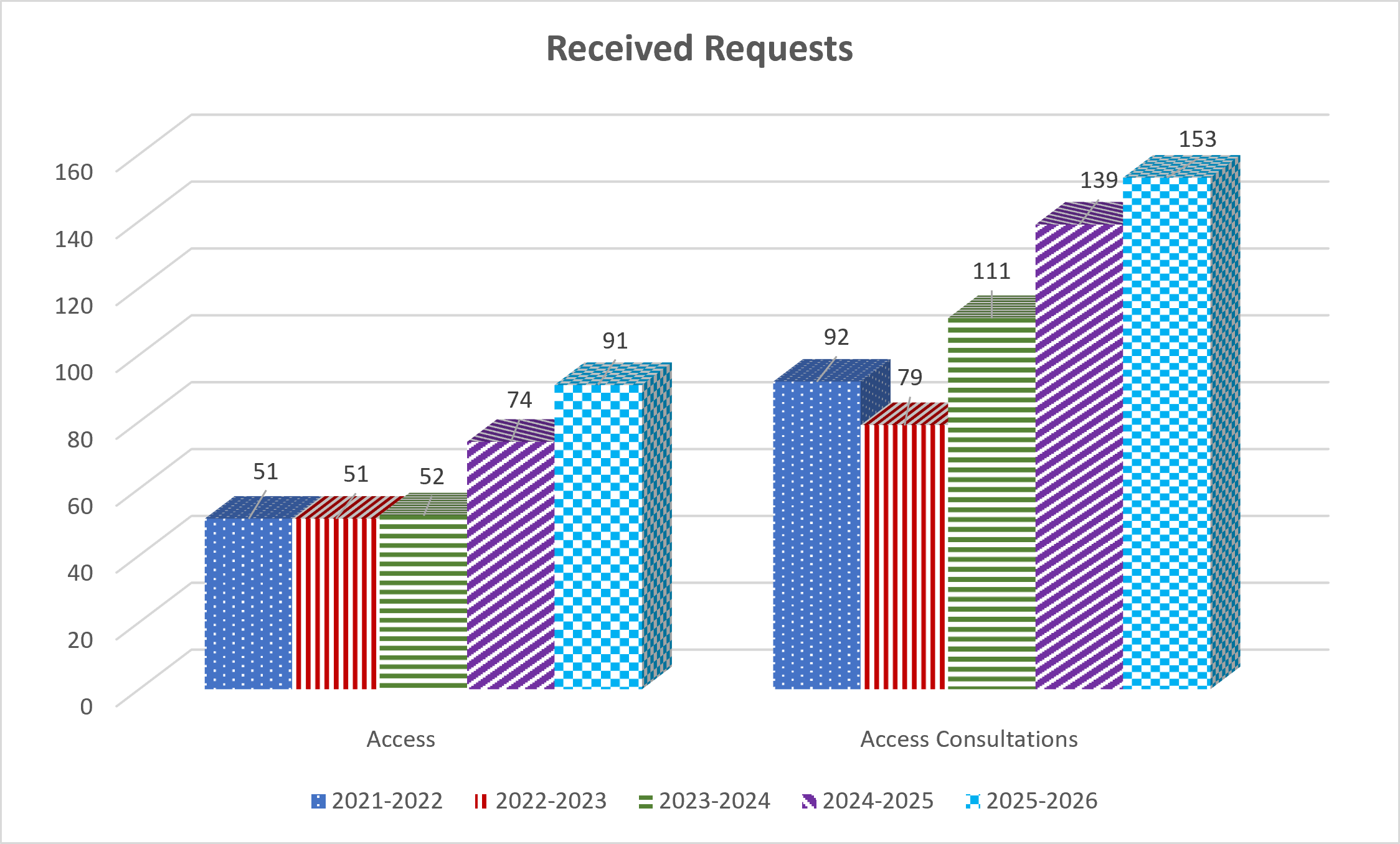
Long description - Received requests
| Source | 2021 to 2022 | 2022 to 2023 | 2023 to 2024 | 2024 to 2025 | 2025 to 2026 |
|---|---|---|---|---|---|
| Access | 51 | 51 | 52 | 74 | 91 |
| Access consultations | 92 | 79 | 111 | 139 | 153 |
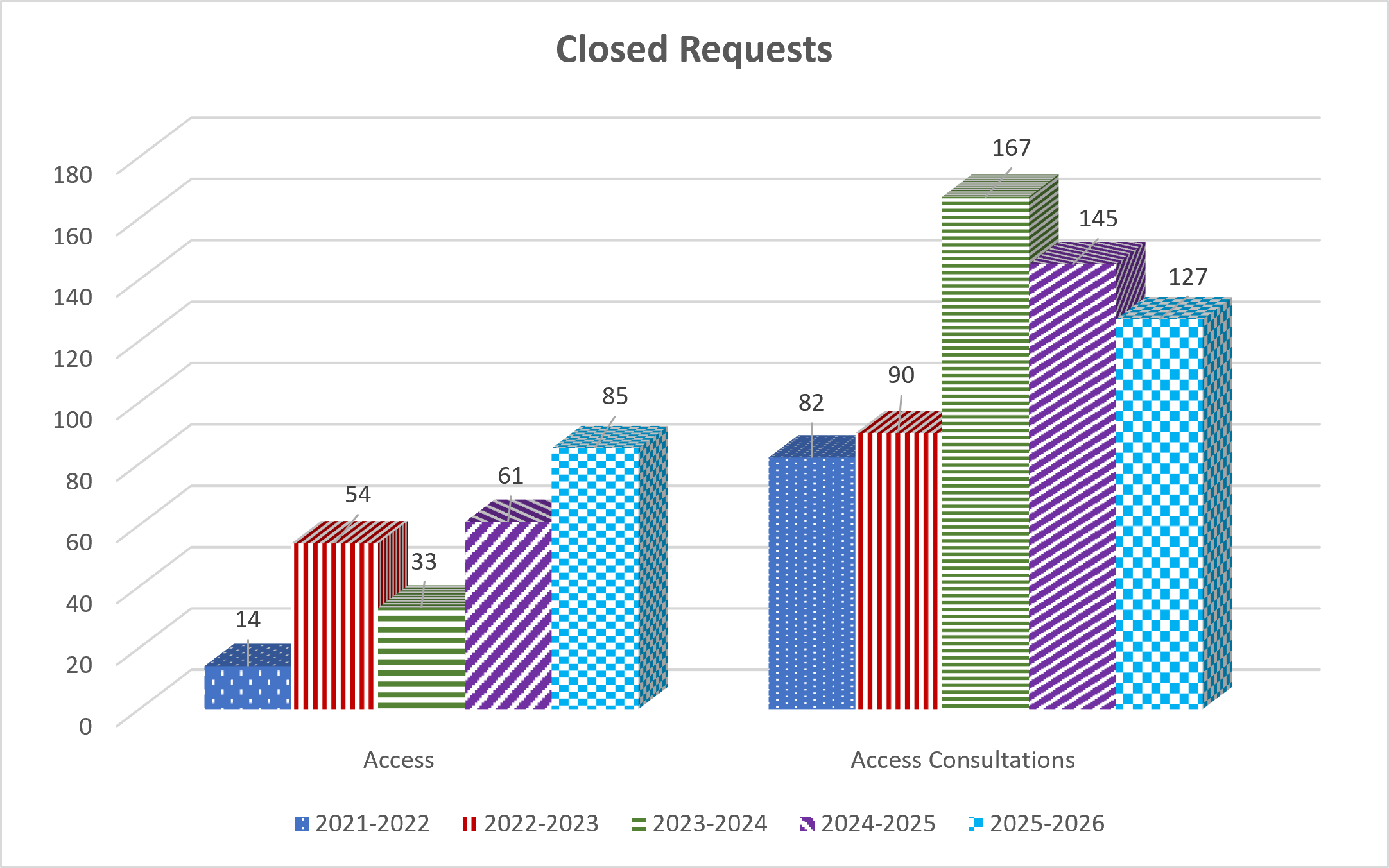
Long description - Closed requests
| Source | 2021 to 2022 | 2022 to 2023 | 2023 to 2024 | 2024 to 2025 | 2025 to 2026 |
|---|---|---|---|---|---|
| Access | 14 | 54 | 33 | 61 | 85 |
| Access consultations | 82 | 90 | 167 | 145 | 127 |
Disposition of completed requests
CSE closed 85 requests during this reporting period. Of these, one (1) (1%) was disclosed in full, fourty-five (45) (53%) were disclosed in part, and 0 were fully exempted. There were twenty-four (24) cases in which no records existed, and nine (9) requests were abandoned by the applicants. The closed requests encompassed 15,604 pages processed, a decrease from the 16,4617 pages processed in 2024-2025. This decline in pages processed can be attributed to the type and amount of information amassed in the requested files as well as the number of requests closed.
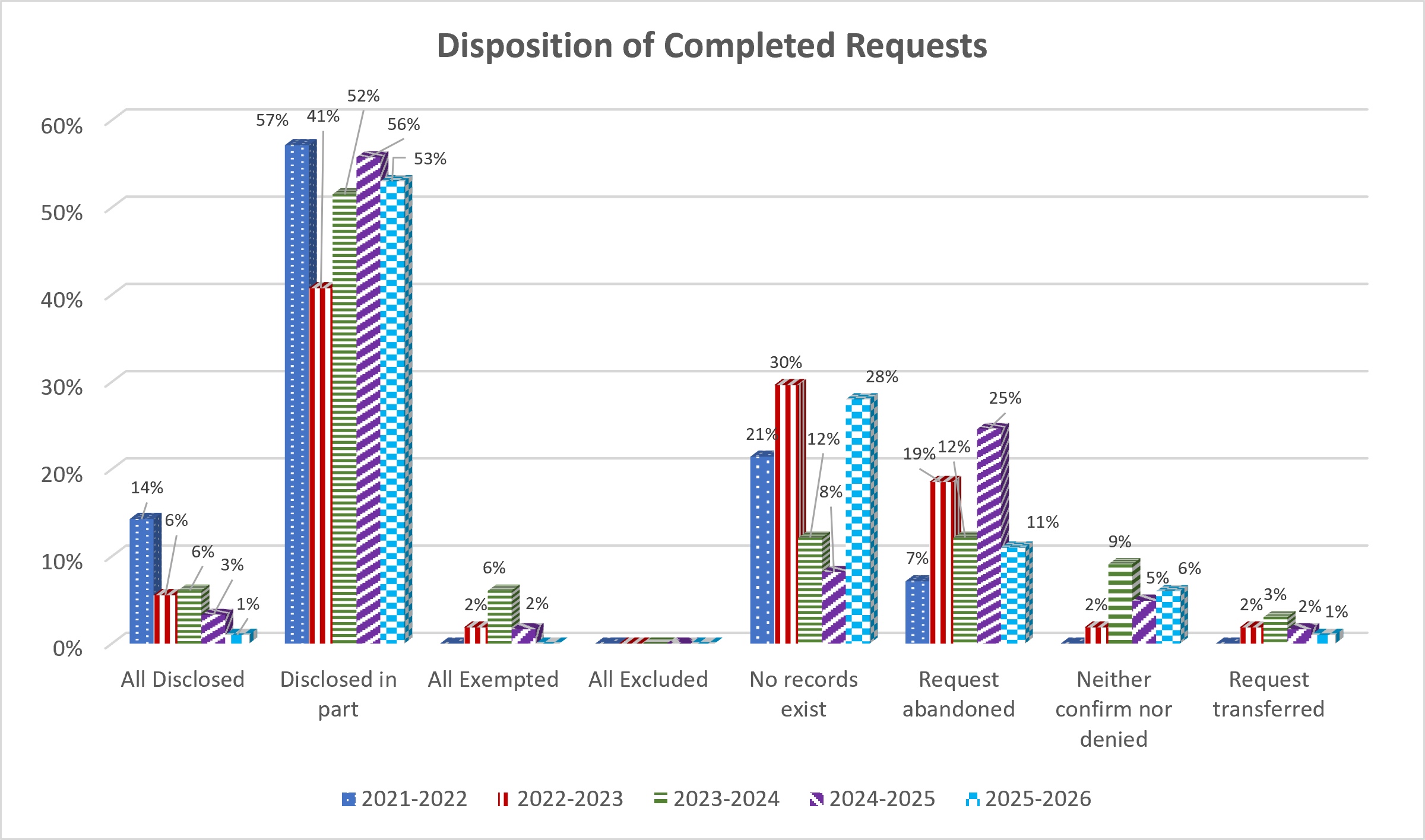
Long description - Disposition of completed requests
| Disposition | 2021 to 2022 | 2022 to 2023 | 2023 to 2024 | 2024 to 2025 | 2025 to 2026 |
|---|---|---|---|---|---|
| All disclosed | 14% | 6% | 6% | 3% | 1% |
| Disclosed in part | 57% | 41% | 52% | 56% | 53% |
| All exempted | 0% | 2% | 6% | 2% | 0% |
| All excluded | 0% | 0% | 0% | 0% | 0% |
| No records exist | 21% | 30% | 12% | 8% | 28% |
| Request abandoned | 7% | 19% | 12% | 25% | 11% |
| Neither confirm nor denied | 0% | 2% | 9% | 5% | 6% |
| Request transferred | 0% | 2% | 3% | 2% | 1% |
Neither confirm nor deny
Section 10(2) of the Act states that institutions do not have to disclose to a requester whether a record exists. Section 10(2) was designed to address situations in which the mere confirmation of a record’s existence (or non-existence) would reveal information that could be protected under the Act. Access to information best practices recommend that the application of section 10(2) be limited to circumstances where the confirmation or denial of the existence of a record would be injurious to Canada’s foreign relations, the defence of Canada, law enforcement activities, the safety of individuals, or the possible disclosure of personal information. When notifying a requester that it is invoking this provision, institutions must also indicate the part of the Act on which a refusal could reasonably be expected to be based if the record existed. The application of subsection 10(2) was used in five (5) cases during the 2025-2026 reporting period.
Completion time
Thirty-four (34) requests made under the ATIA were closed within legislated timelines in the 2025-2026 reporting period. These thirty-four (34) requests represent 40% of the total requests completed. CSE closed twenty (20) requests within 0-30 days; nine (9) between 31 and 60 days; twelve (12) between 61 and 120 days; seven (7) between 121 and 180 days; seventeen (17) between 181 and 365 days; and twenty (20) took more than 365 days to process. 184 requests were carried forward into 2026-2027 compared to 178 from 2024-2025 into 2025-2026. This increase from the previous reporting period can be attributed to the increased number of requests received. CSE will endeavour to improve on the timeliness of responses. In general, the requests received during 2025-2026 involved information of a highly sensitive nature, resulting in considerable complexity in fulfilling them. Of the total requests carried over into 2026-2027, 17 (7%) were received during the 2025-2026 reporting period.
| Reporting period received | Within legislated timelines | Beyond legislated timelines | Total |
|---|---|---|---|
| 2016 to 2017 or earlier | 0 | 33 | 33 |
| 2017 to 2018 | 0 | 17 | 17 |
| 2018 to 2019 | 1 | 7 | 8 |
| 2019 to 2020 | 0 | 15 | 15 |
| 2020 to 2021 | 0 | 11 | 11 |
| 2021 to 2022 | 0 | 8 | 8 |
| 2022 to 2023 | 2 | 9 | 11 |
| 2023 to 2024 | 0 | 18 | 18 |
| 2024 to 2025 | 1 | 9 | 10 |
| 2025 to 2026 | 26 | 27 | 53 |
| Total | 30 | 154 | 184 |
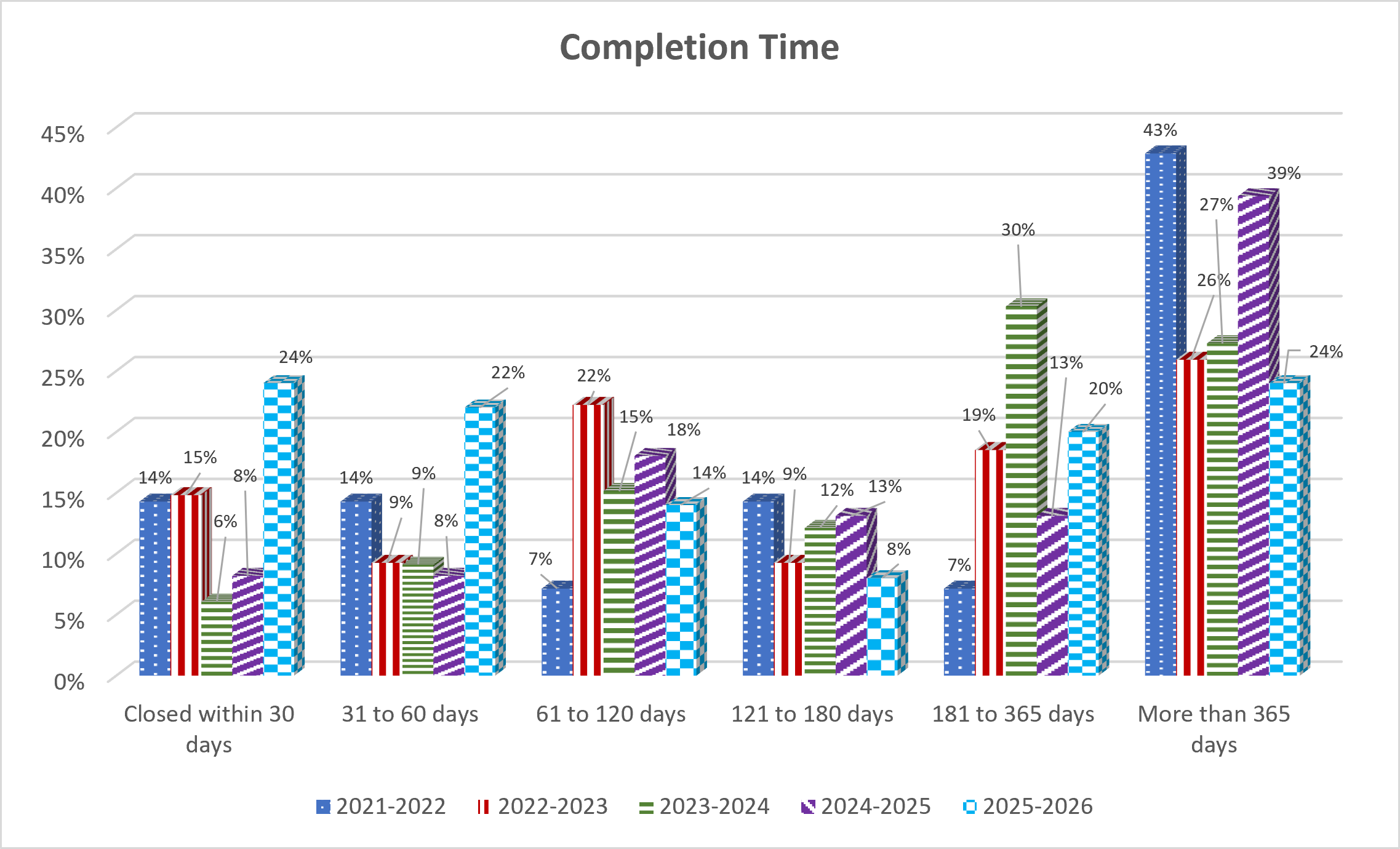
Long description - Completion time
| Completion time | 2021 to 2022 | 2022 to 2023 | 2023 to 2024 | 2024 to 2025 | 2025 to 2026 |
|---|---|---|---|---|---|
| Closed within 30 days | 14% | 15% | 6% | 8% | 24% |
| 31 to 60 days | 14% | 9% | 9% | 8% | 22% |
| 61 to 120 days | 7% | 22% | 15% | 18% | 14% |
| 121 to 180 days | 14% | 9% | 12% | 13% | 8% |
| 181 to 365 days | 7% | 19% | 30% | 13% | 20% |
| More than 365 days | 43% | 26% | 27% | 39% | 24% |
Exemptions to the release of information
The exemption most applied by CSE was subsection 15(1) - Defence of the Access to Information Act. It was applied to protect information which could be reasonably expected to be injurious to the defence of Canada on fourty (40) requests. Subsection 15(1) – International Affairs was also used twenty-three (23) times to protect information that could be injurious to the conduct of international affairs. Other frequently used exemptions that were applied throughout the course of the fiscal year are paragraphs; 19(1), personal information of individuals; 13(1)(a), information that was obtained in confidence from the government of a foreign state or an institution thereof; and 23, information that is subject to solicitor-client privilege or the professional secrecy of advocates and notaries or to litigation privilege.
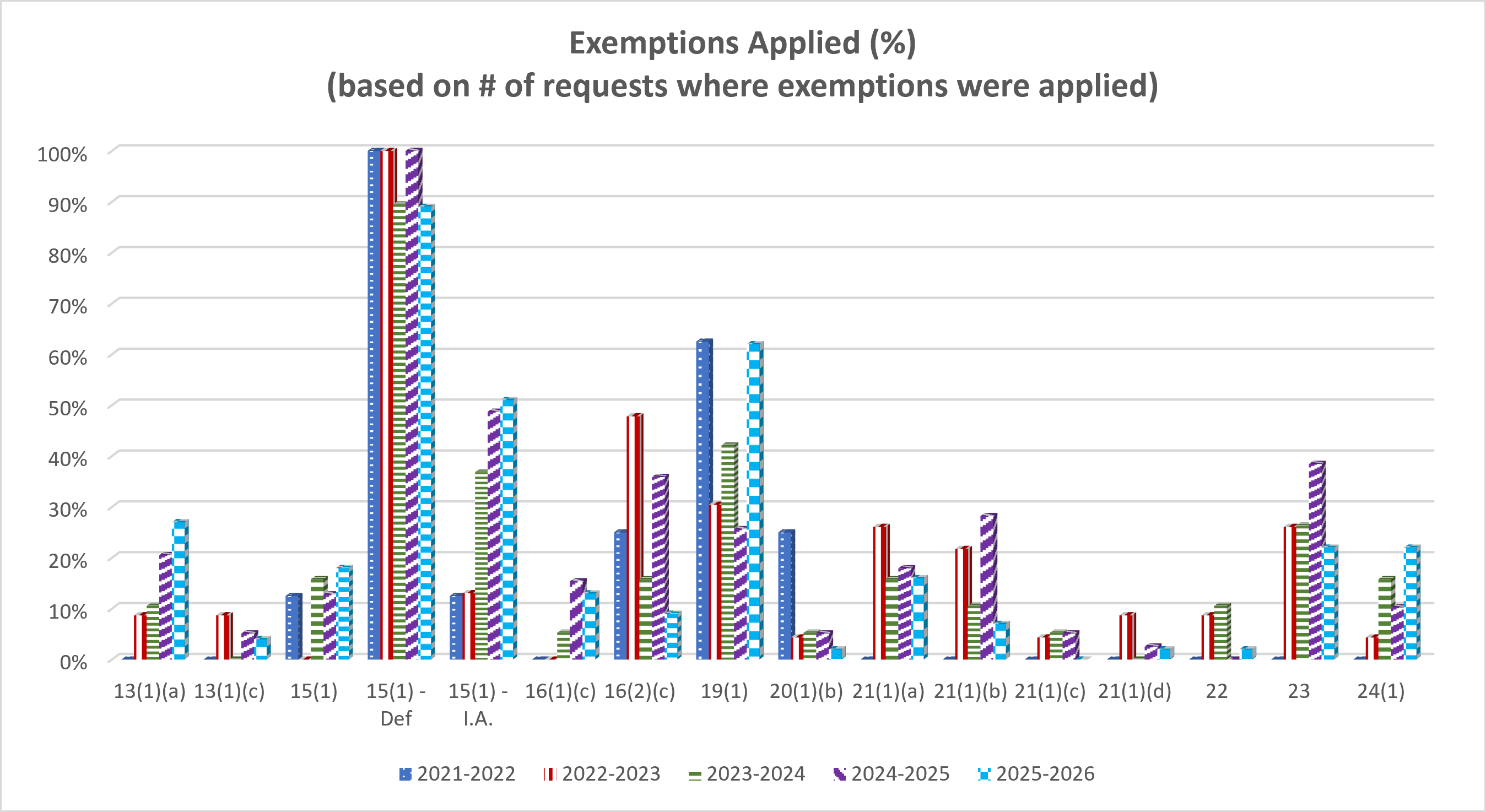
Long description - Exemptions applied
| Disposition | 2021 to 2022 | 2022 to 2023 | 2023 to 2024 | 2024 to 2025 | 2025 to 2026 |
|---|---|---|---|---|---|
| 13(1)(a) | 0% | 9% | 11% | 21% | 27% |
| 13(1)(c) | 0% | 9% | 0% | 5% | 4% |
| 15(1) | 13% | 0% | 16% | 13% | 18% |
| 15(1) - Def | 100% | 100% | 89% | 100% | 89% |
| 15(1) - I.A. | 13% | 13% | 37% | 49% | 51% |
| 16(1)(c) | 0% | 0% | 5% | 15% | 13% |
| 16(2)(c) | 25% | 48% | 16% | 36% | 9% |
| 19(1) | 63% | 30% | 42% | 26% | 62% |
| 20(1)(b) | 25% | 4% | 5% | 5% | 2% |
| 21(1)(a) | 0% | 26% | 16% | 18% | 16% |
| 21(1)(b) | 0% | 22% | 11% | 28% | 7% |
| 21(1)(c) | 0% | 4% | 5% | 5% | 0% |
| 21(1)(d) | 0% | 9% | 0% | 3% | 2% |
| 22 | 0% | 9% | 11% | 0% | 2% |
| 23 | 0% | 26% | 26% | 38% | 22% |
| 24(1) | 0% | 4% | 16% | 10% | 22% |
Extension of the time limit
There were eight (8) extensions taken pursuant to paragraph 9(1)(a) of the Access to Information Act. CSE claimed twenty (20) extensions under 9(1)(b) to conduct consultations that could not reasonably be completed within the original time limit. No extensions were claimed under paragraph 9(1)(c) to conduct third party consultations in accordance with subsection 27(1) of the Act. This increase from the 2024-2025 reporting period can be attributed to changes to the organization of the ATIP Office, enabling the ATIP Intake team and the OPIs to retrieve and review records so that appropriate extensions could be taken within legislated timelines.
Consultations
CSE was consulted on 154 requests during this fiscal year compared to 140 for the previous reporting period. Other federal government institutions accounted for 153 of the consultations while one (1) was received from an organization outside of the Federal Government. In addition to the 154 new consultations, 35 were carried over from 2024-2025, resulting in 190 ongoing consultation requests in 2025-2026. CSE closed 129 consultations with a total of 9,594 pages processed. 61 consultations have been carried over into 2026-2027. Consultation requests for records of historical nature (e.g. during the Cold War era) continue to contribute to the volume of consultations though significant effort was made to reduce this number throughout 2024-2025 and 2025-2026. These historical consultation requests comprise 38 of the 61 consultations carried over into 2026-2027. The historical requests are voluminous in nature and have impacted on the ATIP Operations team’s ability to close other requests in a timely fashion.
Of the 129 consultations closed, twenty (20) were closed within the first 15 days; twenty (20) in 16-30 days; forty-one (41) in 31-60 days; twenty-eight (28) between 61-120 days; ten (10) in 121-180 days; ten (10) in 181-365 days; and no requests took more than 365 days.
Requests treated informally
CSE closed 91 informal requests during this reporting period. CSE responded to ten (10) requests between 0-15 days; two (2) requests between 16 to 30 days; nineteen (19) requests between 31 to 60 days; forty-six (46) requests between 61 to 120 days; nine (9) requests between 121 to 180 days; one (1) request between 181 to 365 days and four (4) requests more than 365 days.
Complaints, judicial review and audits
Individuals who are not satisfied with the processing of their access to information request can file a complaint with the Office of the Information Commissioner of Canada (OIC).
The OIC notified CSE of eighteen (18) complaints in 2025-2026, a slight increase from the seventeen (17) received in 2024-2025 and closed nine (9) complaints. CSE provided information to the OIC in relation to all complaint notifications as requested.
Five (5) of the complaints received during the reporting period were a result of delays in responding to requests. Eleven (11) alleged that CSE had improperly applied exemptions to unjustifiably deny access to records. Of these, eight (8) included allegations of missing records. Two (2) complaints alleged that CSE took an unreasonable extension.
In 2025-2026, CSE made formal representations on nine (9) complaints, with additional representations provided on two (2) in response to questions from the OIC. Form Bs were completed for five (5) delay complaints, two (2) of which were received during the 2024-2025 reporting period, the remainder in 2025-2026. Representations were made on two (2) exemption complaints, both of which were received in the previous reporting period. Representations were also made on two (2) extension complaints, one (1) of which was received in the current reporting period. The other was received in 2024-2025.
The OIC provided letters notifying CSE that it had ceased to investigate three (3) complaints. The OIC issued initial reports on four (4) complaints. All initial reports indicated the complaints were well-founded, with the intent of making orders. Final reports were issued on six (6) complaints. Three (3) complaints were well-founded, with orders, one (1) was well-founded and resolved, and two (2) included a finding that the request was not well-founded. CSE complied with the orders.
At the end of 2025-2026, the OIC had twenty-one (21) open complaints with CSE. CSE continues to work closely with the OIC to resolve complaints in an efficient and transparent manner.
| Reporting period received | Number of open complaints |
|---|---|
| 2016 to 2017 or earlier | 0 |
| 2017 to 2018 | 1 |
| 2018 to 2019 | 0 |
| 2019 to 2020 | 0 |
| 2020 to 2021 | 0 |
| 2021 to 2022 | 0 |
| 2022 to 2023 | 1 |
| 2023 to 2024 | 4 |
| 2024 to 2025 | 1 |
| 2025 to 2026 | 14 |
| Total | 21 |
Training and awareness
CSE is committed to the ongoing learning and development of its employees and has put a special emphasis on reaching new hires by delivering ATIP training to incoming co-op students. All new employees are required to complete ATIP training during CSE’s on-boarding process.
The ATIP Office delivered one (1) formal training session to a group that requested training on recognizing Cabinet Confidences. This session was provided for fifteen (15) CSE employees and acted as an awareness session for newer ATIP analysts. The ATIP Office has also continued outreach to the Offices of Primary Interest (OPI) when responding to requests on their roles and responsibilities. For example, advising how and where to search for records; how to retrieve them; how to determine which records are responsive; and how to send the responsive records to the ATIP Office. This training also touches on best practices in information management to best respond to future requests.
In addition to this, the ATIP Office delivered 10 informal briefings and one-on-one training sessions during the reporting period to approximately 21 individuals as well as participating in awareness sessions for co-op students.
CSE encourages employees to take Canada School for Public Service (CSPS) ATIP training courses and the ATIP Office continues to make educational resources available via a dedicated page on the internal web. New employees are required to complete an online training session “Access to Information and Privacy Fundamentals” within three months of their start date.
Policies, guidelines, and procedures
CSE did not introduce any new policies, guidelines, or procedures to comply with any new Treasury Board of Canada Secretariat policies and directives or in response to issues raised by the Office of the Information Commissioner or other Agents of Parliament. However, the ATIP Office did implement some measures to increase efficiency.
The current reporting period marks the second full year the ATIP Office assumed full responsibility for proactive disclosures, including the proactive disclosure of all materials prepared for the CSE Chief appearing before Parliamentary Committees, or transition binders for the Minister of National Defence. This included the assumed responsibility for coordinating translation and web publishing of all relevant materials. Processes have been established to complete the review and publication efficiently and in a timely manner.
The teams are also actively recruiting new hires both internal and external to the federal government. It is important to note though that CSE’s hiring process is conducted in three phases which can take anywhere from 6-12 months or longer thereby making it challenging to respond quickly to staffing needs.
Proactive publication under Part 2 of the ATIA
CSE is a government institution as defined in section 3 of the Access to Information Act and in Schedule I.1 of the Financial Administration Act. CSE is subject to sections 82 to 88 of the ATIA, except for section 85. CSE also supports the Department of National Defence in their compliance with sections 74 (a) and (c) as needed.
CSE posts briefing material to the Chief, CSE (deputy head) to Open.Canada.ca. Reports tabled in Parliament and briefing material for the Chief in support of parliamentary committee appearances as well as briefing material (transition binder) for a new Chief are published on CSE’s public website.
Bill C-58 requires briefing packages for Parliamentary Committee appearances to be published 120 calendar days following the appearance.
Of the four (4) binders CSE published this fiscal year, all (100%) of the binders were published within the reporting period.
Fiscal year 2025-26
- House Standing Committee on National Defence (NDDN) Supplementary Estimates B - December 4, 2025
- House Standing Committee on National Defence (NDDN) Binder - October 21, 2025
- Standing Senate Committee on National Finance (NFFN): June 19, 2025
- Transition binder for the Honourable David McGuinty, Minister of National Defence - May 13, 2025
CSE does not currently disclose travel and hospitality expenses, contracts over $10,000 or grants and contributions over $25,000. CSE is required under legislation to disclose this information and is currently developing processes to ensure that the release of travel locations and business partnerships is not injurious to national security.
| Legislative requirement | Section of ATIA | Publication timeline | Does requirement apply to your institution (yes/no)? | Internal group(s) or positions(s) responsible for fulfilling requirement | % of proactive publication requirements published within legislated timelines* | Link to web page where published** |
|---|---|---|---|---|---|---|
| All government institutions as defined in section 3 of the Access to Information Act | ||||||
| Travel expenses | 82 | Within 30 days after the end of the month of reimbursement | Yes | - | - | Not currently being published |
| Hospitality expenses | 83 | Within 30 days after the end of the month of reimbursement | Yes | - | - | Not currently being published |
| Reports tabled in Parliament | 84 | Within 30 days after tabling | Yes | ATIP Office | 100% | Reports - Communications Security Establishment Canada |
| Apply to government entities or Departments, agencies, and other bodies subject to the Act and listed in Schedules I, I.1, or II of the Financial Administration Act | ||||||
| Contracts over $10,000 | 86 | Q1-3: Within 30 days after the quarter Q4: Within 60 days after the quarter |
Yes | - | - | Not currently being published |
| Grants and contributions over $25,000 | 87 | Within 30 days after the quarter | Yes | - | - | Not currently being published |
| Packages of briefing materials prepared for new or incoming deputy heads or equivalent | 88(a) | Within 120 days after appointment | Yes | - | - | No new deputy head in 2025-2026 reporting period |
| Titles and reference numbers of memoranda prepared for a deputy head or equivalent, that is received by their office | 88(b) | Within 30 days after the end of the month received | Yes | ATIP Intake | 100% | Open.Canada.ca |
| Packages of briefing materials prepared for a deputy head or equivalent’s appearance before a committee of Parliament | 88(c) | Within 120 days after appearance | - | Packages of briefing materials prepared for a deputy head or equivalent’s appearance before a committee of Parliament | 88(c) | Proactive disclosure - Communications Security Establishment Canada |
| Applies to government institutions that are departments named in Schedule I to the Financial Administration Act or portions of the core public administration named in Schedule IV to that Act (i.e. government institutions for which Treasury Board is the employer) | ||||||
| Reclassification of positions | 85 | Within 30 days after the quarter | No | - | - | - |
| Apply to Ministers’ Offices (therefore apply to any institution that performs proactive publication on behalf of a Minister’s Office) | ||||||
| Packages of briefing materials prepared by a government institution for new or incoming ministers | 74(a) | Within 120 days after appointment | No | - | - | CSE contributes to National Defence Publications |
| Titles and reference numbers of memoranda prepared by a government institution for the minister, that is received by their office | 74(b) | Within 30 days after the end of the month received | No | - | - | - |
| Package of question period notes prepared by a government institution for the minister and in use on the last sitting day of the House of Commons in June and December | 74(c) | Within 30 days after last sitting day of the House of Common in June and December | No | - | - | CSE contributes to National Defence publications |
| Packages of briefing materials prepared by a government institution for a minister’s appearance before a committee of Parliament | 74(d) | Within 120 days after appearance | No | - | - | - |
| Travel expenses | 75 | Within 30 days after the end of the month of reimbursement | No | - | - | - |
| Hospitality expenses | 76 | Within 30 days after the end of the month of reimbursement | No | - | - | - |
| Contracts over $10,000 | 77 | Q1-3: Within 30 days after the quarter Q4: Within 60 days after the quarter |
No | - | - | - |
| Ministers’ offices expenses Note: This consolidated report is currently published by TBS on behalf of all institutions. |
78 | Within 120 days after the fiscal year | No | - | - | - |
Following a committee appearance, CSE’s Parliamentary Affairs sends the preparatory binder to ATIP for consultation. ATIP Intake will review and apply any necessary redactions accordingly following management approval.
The ATIP analyst sends the binder to Linguistic Services to have each document translated. Since there are several binders, many items in the binders may be identical or similar to previous binders that have been published, or that are seeking to be published. In that case, the analyst makes sure to highlight the similarities and differences between each item and identifies them to our Linguistic Services team. If the document has already been translated, this alleviates any duplication of work. Once Linguistic Services returns the French translated documents, the analyst verifies if the document (formatting, content, etc.) aligns with the English binders, before sending it to the Web Team for publication.
ATIP prepares a briefing note for the Chief, CSE (Deputy Minister) for final approval. The Chief reviews the material that will be published prior to it being posted on the webpage. For each new preparatory binder that is proactively disclosed, the ATIP team monitors and reviews similarly disclosed materials to ensure overall consistency.
Prior to sending a request to the Web Team to have the binder published, the analyst includes each document found in the binder into a Word document in effort to compile the documents and facilitate accessibility for the Web Team. The analyst also fills out a publication template to meet the Web Team’s requirements to proactively disclose the briefing material. The Web Team is also notified if there are any similarities or differences between binders.
Lessons learned include:
- Reviewing materials to determine duplicative materials saves time for each of the Linguistic Services, ATIP, and Web teams.
- It is critical to begin the proactive disclosure process as soon as materials are finalized.
- When preparing binders, it is critical to ensure they are designed with accessibility requirements in mind to help support our Web team comply with TBS web publishing standards.
CSE was able to meet the legislative deadlines due to the increased familiarity with the process and having time to streamline processes to improve compliance.
The CSE ATIP is responsible for the publication of briefing notes to the Chief, CSE monthly. Once retrieved, the list of briefing notes is reviewed for redactions which are then confirmed by the subject matter experts and the Chief’s Office. The finalized list is translated and published to Open.Canada.ca as indicated above. All (100%) of the monthly lists were published within the established timelines.
Initiatives and projects to improve Access to information
CSE proactively publishes ATIA request summaries, reports and other publications to the Open Gov portal as well as other material on its own external site. Visitors to CSE’s main external site can also find information on the laws and authorities that govern CSE’s activities, oversight and review bodies that ensure CSE activities comply with the law, steps on how to make an official complaint to the Chief of CSE, and laws and policies CSE follows to protect the privacy of Canadians.
CSE is also part of the National Security Transparency Commitment which strives to increase Canadians’ understanding of what the Government does to protect national security, how the Government does it, and why such work is important.
The ATIP Office works in conjunction with CSE’s Open Government unit to promote transparency and information sharing to the Canadian public. The former is responsible for posting ATIP request summaries and coordinating the review of material for publication under Part 2 of the Act while the latter works within the organization to identify datasets that can be shared publicly while not specified for publication under the Act.
The CSE Open Government Working Group (COGWG) proactively works to identify and release unclassified information that may be of interest to Canadians. By embracing transparency, collaboration, and accountability, we not only strengthen public trust but also improve the quality and impact of our work. Open government enables us to share information more effectively, encourages meaningful participation, and uses data to inform decisions that affect Canadians. Transparency increases awareness of CSE publications and reduces duplication of effort for CSE personnel having to respond to fewer access to information (ATIP) requests from the public.
In the 2025-2026 fiscal year, CSE uploaded 5 datasets and 56 publications to the Open Government Portal. The COGWG engages with internal stakeholders monthly to locate potential new data to upload to the OG portal, with the intent to upload a minimum of twice per fiscal year.
CSE also follows internal procedure for posting information to the Open Government portal which includes review by ATIP, Legal Services and Security and approval by the CSE Open Government Group and Director General.
CSE has continued to improve processes by using the ATIP Online Management Tool (AOMT) which replaced the ATIP Online Request Service (AORS) in this reporting period. The AOMT is a centralized website developed by TBS that enables users to complete access to information requests and submit them to any of the institutions that are subject to the Government of Canada’s Access to Information Act. CSE received 89 requests via this service, representing approximately 98% of the total requests received. This is an increase from 83% in 2024-2025. The remaining 2% were received by email.
It is important to note that the ATIP Office also supports the work of the National Security Intelligence Review Agency (NSIRA), the National Security and Intelligence Committee of Parliamentarians (NSICOP), and the Intelligence Commissioner (IC) by reviewing their documents, which contain sensitive CSE information, and providing unclassified versions that can be shared openly with the public.
Non-ATIP related requests have impacted on the time our team can devote to access and privacy requests. This time is not represented in the statistical reporting, but accounts for approximately 0.974 FTE for the reporting period, a decrease from 1.77 in 2024-2025. This reduction largely reflects NSIRA’s shift to formal consultations with CSE under the Access to Information Act.
The ATIP Office is in the process of onboarding to the AMANDA software. This will be implemented in the 2026-2027 reporting period and will help to modernize and streamline processes and enhance monitoring to improve compliance.
Monitoring compliance
Using our case management software, the ATIP Office continues to produce reports on the time taken to process requests. These reports are shared with our ATIP Coordinator throughout the fiscal year. The ATIP Operations team tracks all requests and reports bi-weekly to the team manager on any issues and/or delays in processing requests. This provides an opportunity for the manager to triage requests or allocate resources, for example, to meet legislated timelines. CSE’s Executive Committee (made up of DM and ADM level executives) is also informed of the status of Access to Information Act requests on an ad-hoc basis.
Like many other government departments, CSE is experiencing a backlog in responding to requests for information. The ATIP Office has implemented mechanisms and tools to address this backlog such as the team’s bi-weekly tracker for requests for information and access consultations. The ATIP supervisors and manager are briefed weekly on the number of new requests, closed requests, and are alerted to any backlogs by ATIP analysts. This is an opportunity to discuss how best to triage requests and allocate resources as required to meet legislated timelines.
Appendix I: Delegation of Authority
Communications Security Establishment
Access to Information Act Delegation Order
The Minister of National Defence, pursuant to section 95 of the Access to Information Act, hereby designates the persons holding the positions set out below, or the persons occupying on an acting basis those positions, to exercise the powers, duties and functions of the Minister of National Defence as the head of the Communications Security Establishment Canada (CSE), under the provisions of the Access to Information Act and related regulations set out below for each position.
- Chief, CSE: full authority (including for the Act and related regulations as they were prior to June 21, 2019), except joint authority under subsection 20(6) (public interest disclosure) with the Deputy Chief, Authorities, Compliance and Transparency
- Deputy Chief, Authorities, Compliance and Transparency: full authority (including for the Act and related regulations as they were prior to June 21, 2019), except joint authority under subsection 20(6) (public interest disclosure) with the Chief, CSE
- Director General, Review, Transparency and Information Sharing: full authority (including for the Act and related regulations as they were prior to June 21, 2019), except for subsection 20(6) (public interest disclosure).
- Director, Transparency and Information Sharing: full authority (including for the Act and related regulations as they were prior to June 21, 2019), except for subsection 20(6) (public interest disclosure).
- Manager, Transparency and Disclosures: full authority (including for the Act and related regulations as they were prior to June 21, 2019), except for subsection 20(6) (public interest disclosure).
- Supervisor, Access to Information and Privacy Operations: paragraph 7(a) only when no record exists (notice), section 9 (extension of time limits), section 11 (fees), sections 27 and 28 (consultations to third party documents).
- Supervisor, Access to Information and Privacy Intake: paragraph 7(a) only when no record exists (notice), section 9 (extension of time limits), section 11 (fees), sections 27 and 28 (consultations to third party documents).
This delegation order replaces all previous delegation orders.
Dated at Ottawa, this 18th day of March 2026.
The Honourable David McGuinty, P.C., M.P.
Minister of National Defence